Professional practice that works for every kind of mind.
Aphantasia Academy trains therapists, coaches and organisations to recognise five invisible cognitive differences and adapt the way they work.
Choose your route
Every profession meets these in its own way. Start where your work starts.
I'm a therapist
Adapt therapeutic practice for the minds standard methods weren't built for.
Therapist TrackI'm a coach
Understand when established coaching models don't fit the client's mind.
Coach TrackI represent an organisation
Build more cognitively inclusive services, teams and support.
Organisational trainingI'm looking for support
Find a practitioner who already understands how your mind works.
Find supportWhy established methods don't fit every mind
There's a particular kind of stuck that happens in therapy. The client is engaged, the relationship is good, the practitioner is skilled, and yet something isn't moving. The visualisation exercise that works so reliably for others simply produces nothing at all.
The practitioner looks for resistance, or avoidance, or an unresolved block, because that's what the training map points to. And the client, sensing that something is expected of them they can't produce, quietly begins to wonder whether they're the problem.
These are neurological realities, not psychological blocks. The gap sits in the method, and methods can be adapted.
Each one describes an absence, not a symptom
There's nothing to observe. No behaviour to flag, no distress to score, nothing a client thinks to mention because they've never known anything else.
Absence doesn't show up on standard intake tools. Most clients have never had a name for what they're missing, because neither they nor their practitioner knew the right question to ask.
Multisensory aphantasia
No voluntary mental imagery, in any sense. "Picture a safe place" gives them nothing to work with.
SDAM
They know what happened but can't relive it. Memory is a list of facts, not a scene to step back into.
Anauralia
Silence inside. No replaying a voice, a tune, or how something sounded.
Anendophasia
Wordless thinking, with no inner monologue. "What are you telling yourself?" has no answer.
Alexithymia
Emotion registers in the body but resists naming, so "how did that feel?" stalls before it starts.
Unseen Minds Practitioner® Training
Formerly Aphantasia Therapist Training
Our leading professional credential for therapists and counsellors working across all five: multisensory aphantasia, SDAM, anauralia, anendophasia and alexithymia.
Structured, CPD-accredited training built around named adaptation frameworks, so you leave knowing what to do differently in the room, not only what to name.
Not ready yet? Start with the free masterclass
 Awarded on completion
Start with a masterclass
A short, practical introduction before you commit to anything larger. One for each profession.
CBT For Invisible Cognitive Differences
See what happens when standard CBT meets a client with no mental imagery, no inner voice or no access to autobiographical memory, and what to do about it.
The best place to start if you're new to this work.
When Coaching Models Don't Fit Every Mind
A practical introduction to what can make familiar coaching prompts and models inaccessible, and what to offer instead.
The Unseen Minds Practitioner® Coach Track is in development. See the coach pathway
What practitioners say
This course has been the most helpful professional development I've done all year, by a long shot!
It has made a difference to how I practice and enabled me to work effectively with clients who, without this knowledge, may have had less successful outcomes.
Vital training for all practitioners. Enlightening and incredibly valuable.
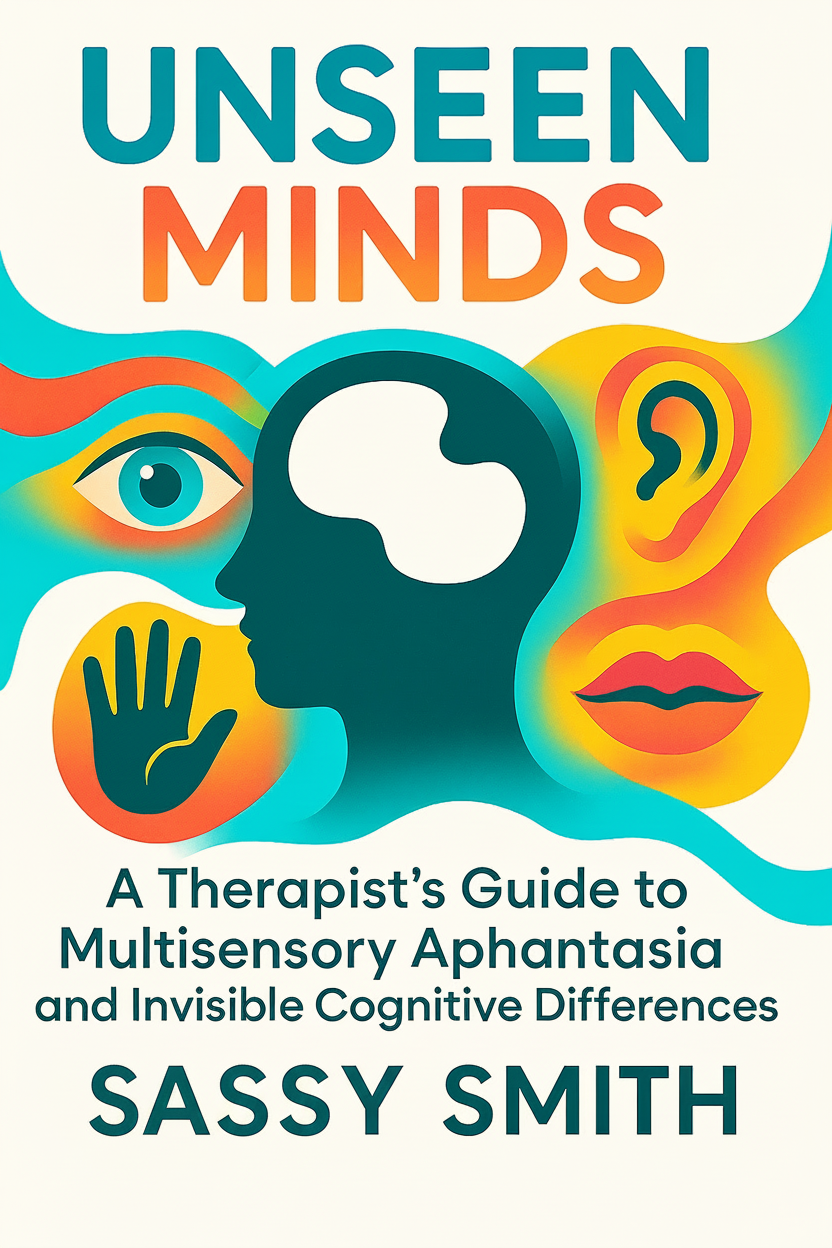
Unseen Minds
A Therapist's Guide to Multisensory Aphantasia and Invisible Cognitive Differences
Second edition · out now
If you've ever had a client who seems engaged and motivated, yet the work still doesn't quite land, this book has answers. It reveals what standard approaches don't accommodate, and shows you how to adapt.
As an independently licensed therapist with multisensory aphantasia myself, I know that many therapeutic techniques fall flat with people with aphantasia. I started to research if anyone had entered this space. This book is sorely needed right now. Janice Lang, licensed therapist · Amazon reviewGet the book
Training for organisations
Keynotes, workshops and bespoke programmes that build cognitively inclusive services and teams.
Delivered to health services, universities and wellbeing providers.
Explore organisational trainingLooking for someone who gets it?
If you've sat opposite a therapist or coach who kept asking you to picture things, or to remember how something felt, and you had nothing to give them, the problem was never you.
Our directory lists practitioners trained by the Academy, so you can find someone who already understands how your mind works and won't need it explained from scratch.
Find a trained practitioner