There's a client in your practice you can't reach yet.
Some clients can't picture anything, some can't relive a memory, some have no inner voice, and some can't name what they feel. Five invisible cognitive differences sit behind these patterns, and most therapists have never been trained to recognise any of them. This is the pathway from noticing that, to knowing exactly what to do about it.
Show me the pathThe clients who leave, and you never know why
These are the moments that send experienced therapists looking for CPD that goes deeper than a tick-box module. If any of them resonate, you're not alone, and it isn't a failure of skill.
When I ask clients to visualise a safe place, some look at me blankly. I assumed they were dissociating, but now I'm not sure.
I asked her to take me back to a time she felt confident, and she told me she doesn't remember her life like that. I didn't know what to do with it.
He says he doesn't know what he's feeling, week after week. I'd been treating it as avoidance.
I had a client who just stopped coming. They seemed engaged, but something wasn't clicking. I still wonder what I missed.
The barrier may not be your skill. It may be a fundamental difference in how your client experiences the world.
people are affected by at least one of the five invisible cognitive differences
have aphantasia and cannot form mental images at all, which is the most recognised of the five
therapists listing aphantasia as a specialism on Counselling Directory trained with Aphantasia Academy. There are ten in the whole of the UK, against more than 27,000 listing ADHD.
The 1 in 10 figure is a conservative cumulative estimate across multisensory aphantasia, SDAM, anauralia, anendophasia and alexithymia. These differences overlap, so people are counted once. Aphantasia prevalence is estimated at 3.9 to 5%. Counselling Directory listings checked August 2026 and correct at that date.
Three steps, and each one stands on its own
You don't have to go from nothing to specialist in a single leap. Each stage is a complete training in its own right, and each builds naturally on the last. Start wherever feels right.
Start here. Discover the blind spot.
A free on-demand masterclass, and the ideal starting point. In 25 minutes you'll see why some clients don't respond to standard CBT techniques, and why the reason is rarely resistance. You'll leave with a new lens on your current caseload and a clear sense of what you might have been missing.
Get the tools. Use them tomorrow.
A focused, five-module training covering aphantasia in full depth, so you can work confidently with aphantasic clients from your very next session. You'll learn to recognise the signs, adapt your existing techniques using the Verbal-Somatic Framework, understand the lived experience of a non-visual mind, and apply it in the room through a narrated case study workshop.
The final module covers how to describe this specialism accurately in your profile, so the clients already searching for someone like you can find you.
The full credential. Become the specialist.
The complete certification for therapists who want to go all in. Over 30 CPD-accredited hours covering all five differences, multisensory aphantasia, SDAM, anauralia, anendophasia and alexithymia, with advanced therapeutic adaptations, risk management, ethical practice and a live integration session.
Graduates hold the credential, carry the badge, and are eligible for the Academy's practitioner directory.
You should never pay twice for the same training.
If you complete Aphantasia Foundations and later decide to pursue the full certification, what you paid for Foundations comes off the price. Every step you take with the Academy counts towards the next one.
The training that changes how you work
This has been so good. I really think it should be mandatory training for all therapists.
I've done a lot of training since I qualified, and none have been as valuable as this one.
It validates my experiences and challenges my practice. I need to work through this again and review every aspect of what I do.
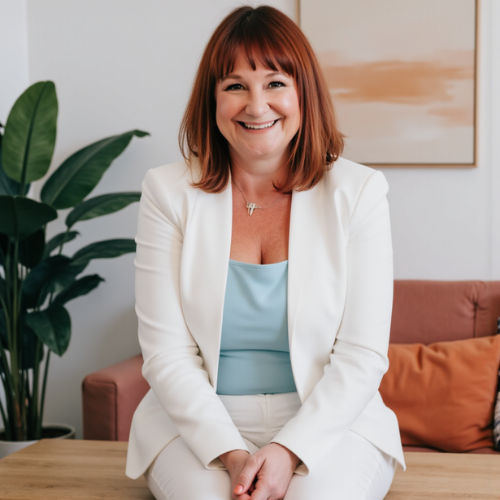
Sassy Smith
Founder, Aphantasia Academy
Sassy lives with all five differences: multisensory aphantasia, SDAM, anauralia, anendophasia and alexithymia. She knows what it feels like to sit in a therapy room and be invisible to the person who is supposed to be helping.
As the creator of the UK's first CPD-accredited training for therapists working with aphantasia and connected cognitive differences, she has trained more practitioners in this field than anyone else in the UK. Seven of the ten therapists currently listing aphantasia as a specialism on Counselling Directory trained with the Academy.
Everything you need to know
Where should I start if I'm completely new to this?
Start with the free masterclass, CBT For Invisible Cognitive Differences. It takes 25 minutes and gives you a clear picture of what aphantasia is and why it matters in your practice. You can then decide whether Foundations or the full certification is the right next step.
Is Foundations a lighter version of the full certification?
No. Aphantasia Foundations is a complete training in its own right, covering aphantasia in full depth and giving you practical tools you can use immediately. The full certification goes further, covering all five differences, with advanced clinical adaptations, a live integration session and formal CPD accreditation.
If I do Foundations, will I pay full price for the certification later?
No. What you paid for Foundations is deducted from the certification price. You should never pay twice for the same training.
How does CPD work across these?
Aphantasia Academy is a registered CPD provider with the CPD Certification Service, so hours spent on any of this training count towards your CPD record. Unseen Minds Practitioner® Training goes further and has itself been assessed and accredited by the CPD Certification Service, with a certificate you can log with your professional body and a digital badge for your directory profiles. Aphantasia Foundations carries a certificate of completion.
How long does each one take?
The masterclass is 25 minutes. Foundations takes most people two to four weeks alongside their existing practice. The full certification is 30+ hours and is typically completed over six to ten weeks. All are self-paced, with lifetime access.
I've already read Unseen Minds. Is the training still worth doing?
Yes. The book gives you the understanding, and the training gives you the tools. Foundations takes you from knowing what aphantasia is to knowing exactly what to do in your next session with an aphantasic client.
The clients who need this are already in your caseload.
They're in your waiting room. They're searching for a therapist who understands them. Start wherever feels right.